Dr. Yan Huang,
Editor, Nature Electronics
Dear Dr. Yan Huang,
Thank you for your response regarding our manuscript, “High-strength liquid metal–hydrogel interfaces enable robust stretchable electronics” (NATELECTRON-25050849). We respectfully request reconsideration of our manuscript.
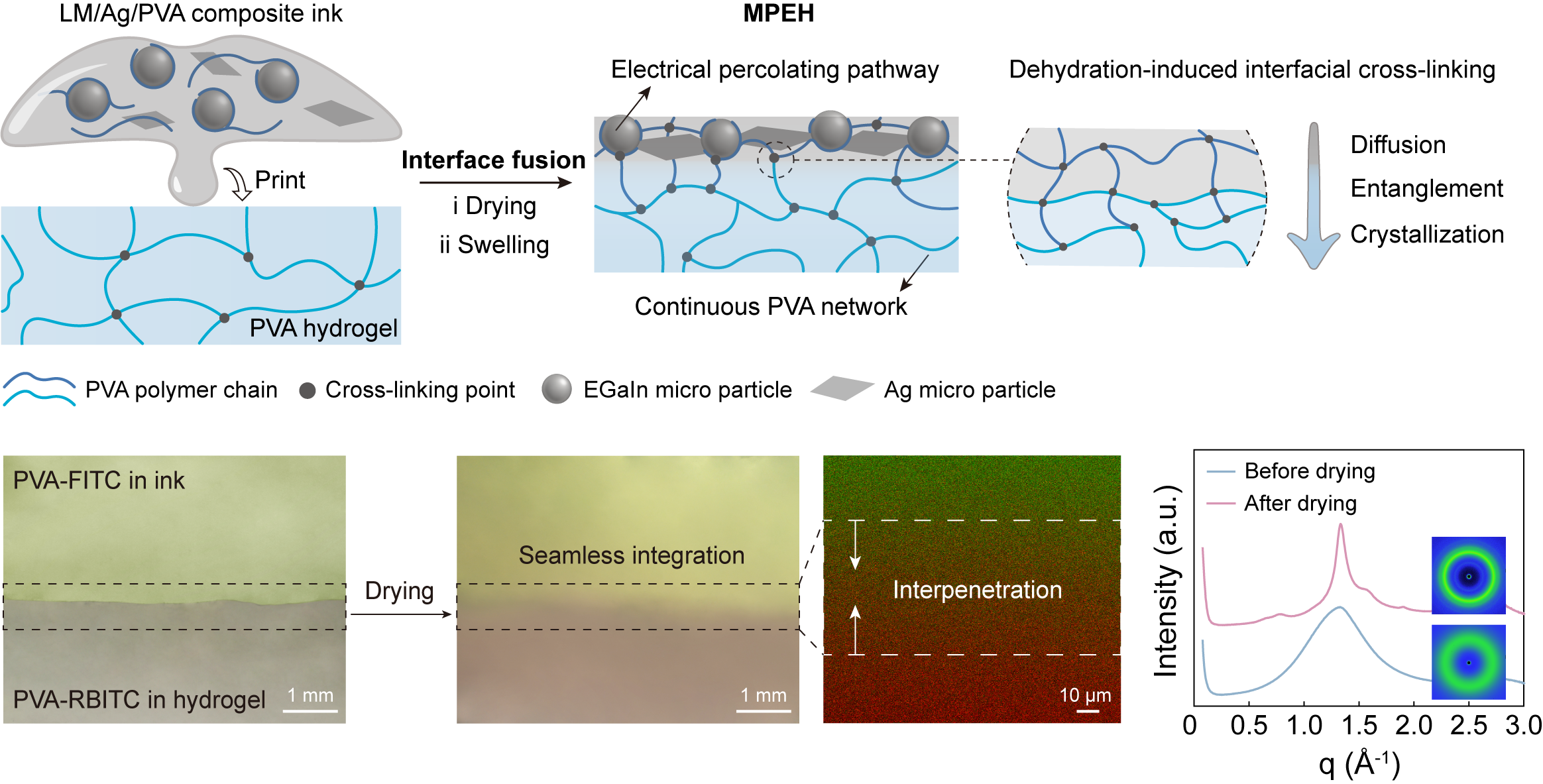
We sincerely appreciate your positive feedback on the depth of our study and the impressive demonstration of the underwater soft robots. In response to your comments, we have strengthened both the scientific understanding and technical demonstration of the interface-fusion printing strategy presented in this study. Specifically, we applied optical microscopy, confocal laser scanning microscopy, and wide-angle X-ray scattering to elucidate the printing process and its underlying mechanism in detail. The corresponding figures have been revised to enhance clarity. In addition, we fabricated flexible circuits on various hydrogel substrates to verify the strategy’s general applicability, thereby underscoring the broad impact of this work. The main contributions of this study are summarised as follows:
Liquid metals (LMs), with their metallic conductivity and extreme deformability, are ideal for stretchable conductors. However, poor interfacial compatibility and adhesion between LMs and flexible substrates render LMs highly prone to leakage under mechanical stress, a persistent issue that severely limits the development of LM-based soft electronics.
Technological performance
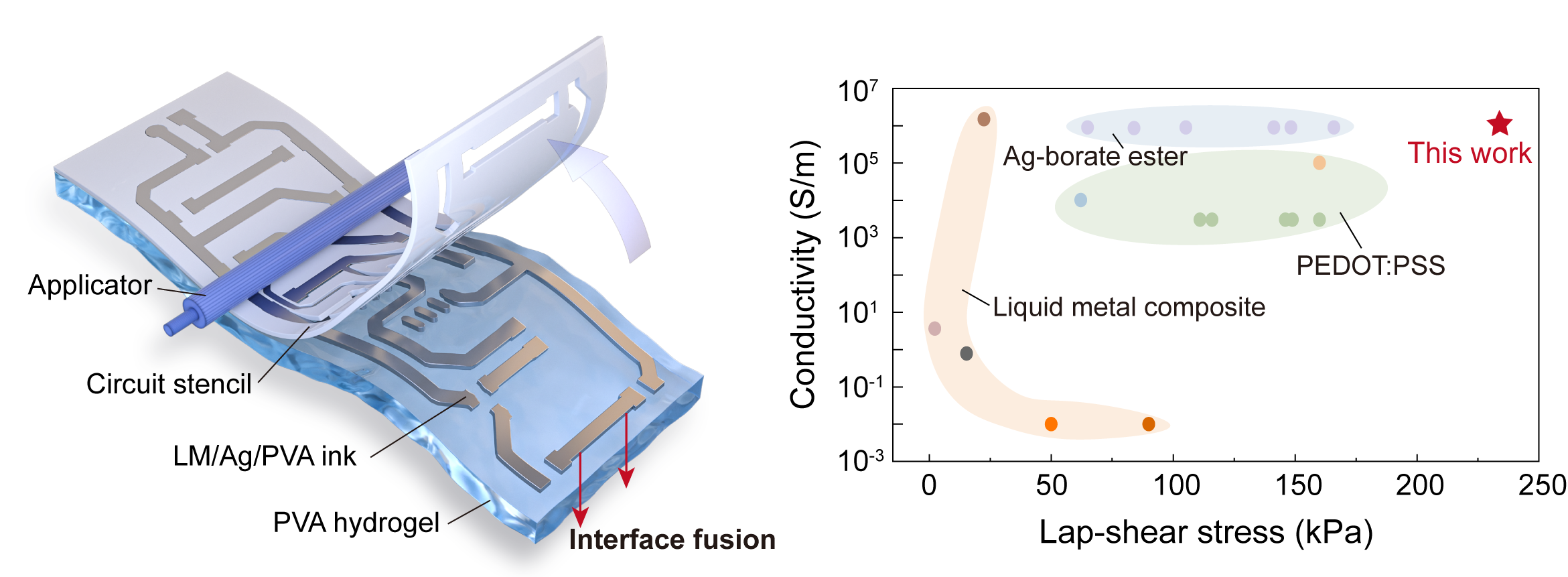
Here, we present a universal interface-fusion printing strategy for fabricating a metal-particle semi-embedded hydrogel (MPEH), in which interconnected liquid metal and silver (LM/Ag) particles are securely anchored at the hydrogel surface. This strategy achieves an interfacial adhesion strength of 234.4 kPa at the circuit–substrate interface—an order of magnitude higher than previously reported for LM circuits (Nat. Electron. 7, 576-585 (2024); Nat. Mater. 20, 851-858 (2021); Adv. Mater. 37, 2415268 (2025)). The robust interface prevents LM leakage and ensures stable electrical connection under extreme conditions, including prolonged ultrasonication, repeated 300 MPa impacts, and thousands of stretching cycles. The LM/Ag circuit is partially embedded at the hydrogel surface, providing excellent surface conductivity (1.18 × 10⁶ S m−1) and enabling direct electrical interfacing with external components. The MPEH exhibits high stretchability (>400%), strain-insensitive resistance (only a 0.15-fold increase at 400% strain), and exceptional underwater electromechanical stability (>7 days). |
Scientific understanding
This strategy employs polyvinyl alcohol (PVA) as a molecular “bridge” by incorporating it into both the hydrogel substrate and the printed LM/Ag/PVA composite ink. Cooperative dehydration simultaneously induces self-crosslinking of the PVA in the ink, which immobilizes the LM/Ag particles, and triggers interfacial cross-linking with the PVA in the hydrogel, thereby forming an interpenetrating crystalline network. This cross-linked network firmly locks the LM/Ag circuit to the hydrogel, standing in sharp contrast to conventional printing techniques. |
Universality and application potential
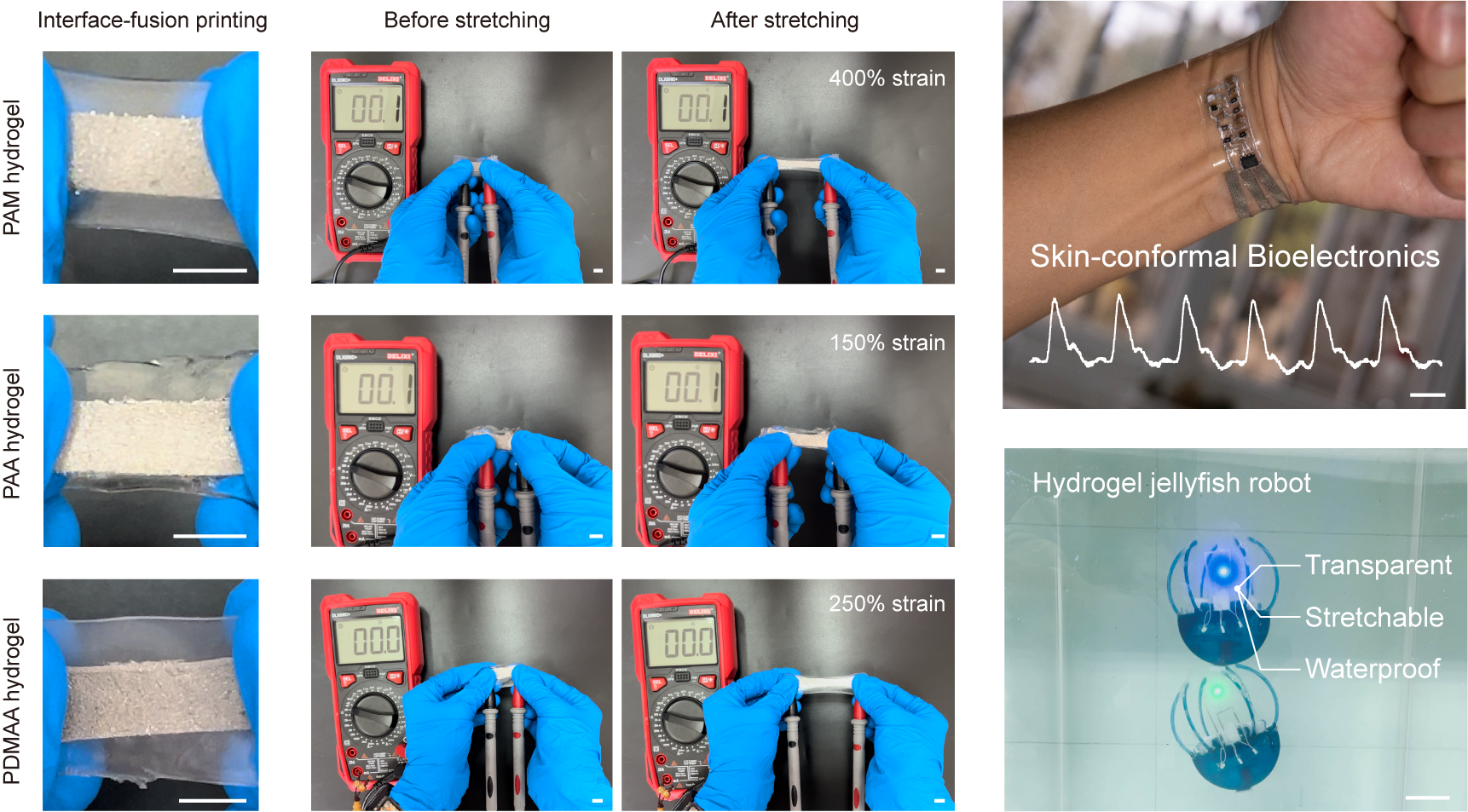
By leveraging the bridging capability of PVA, we further demonstrated that the interface-fusion printing strategy securely anchors LM/Ag circuits onto various hydrogel substrates—including PVA, polyacrylamide, poly(acrylic acid), and poly(N,N-dimethylacrylamide)—highlighting its broad applicability. This method provides a simple and efficient route to fabricating hydrogel-based bioelectronic devices. The MPEH facilitates high-resolution circuit fabrication and supports robust stretchable electronic devices for diverse applications, including stretchable electronics, on-skin biosensors, and underwater soft robots. As a versatile and durable platform, it opens new avenues for the development of next-generation hydrogel bioelectronics, soft robotics, and implantable devices. |
For over two decades, our group has been devoted to advancing hydrogel research, translating fundamental insights into impactful applications in bioelectronics and human–machine interfaces. We believe that the well-elucidated mechanism and broad applicability of the technique presented in this work will stimulate further research in hydrogel bioelectronics and engage the broad readership of Nature Electronics.
Please find attached the revised manuscript and supplementary materials. We would be sincerely grateful if you would consider the revised manuscript for peer review. If you have any questions or need further information, please feel free to contact me. Thank you again for your kind support and consideration.
Sincerely,
Qigang Wang |