|
| |
 |
Gender Equality in China
– A Story of Progress, Perceptions, and Cultural Realities |
|
| |
- As the world celebrates International Women’s Day, the WIN Worldview Survey 2025 provides a global analysis of perceptions related to gender equality based on responses from 34,946 individuals across 39 countries and areas. This study includes valuable insights from China, where WisdomAsia collected data from 1,000 online respondents.
- The findings present a mixed picture of gender equality in China. On one hand, the country ranks above the global average in perceived gender equality, both at home and in the workplace. However, women still bear the brunt of household chores, and significant gender gaps persist in the professional environment.
- Furthermore, while China reports one of the lowest rates of gender-based violence globally, this statistic raises an important question: Does it indicate genuine progress in women's safety, or are incidents simply underreported?
- Overall, these findings suggest that, although attitudes towards gender equality have evolved in China, deeply rooted cultural norms continue to shape how gender equality is perceived and experienced.
|
|
| |
 |
I. Global Gender Equality in 2025: A Regional Perspective |
|
|
| |
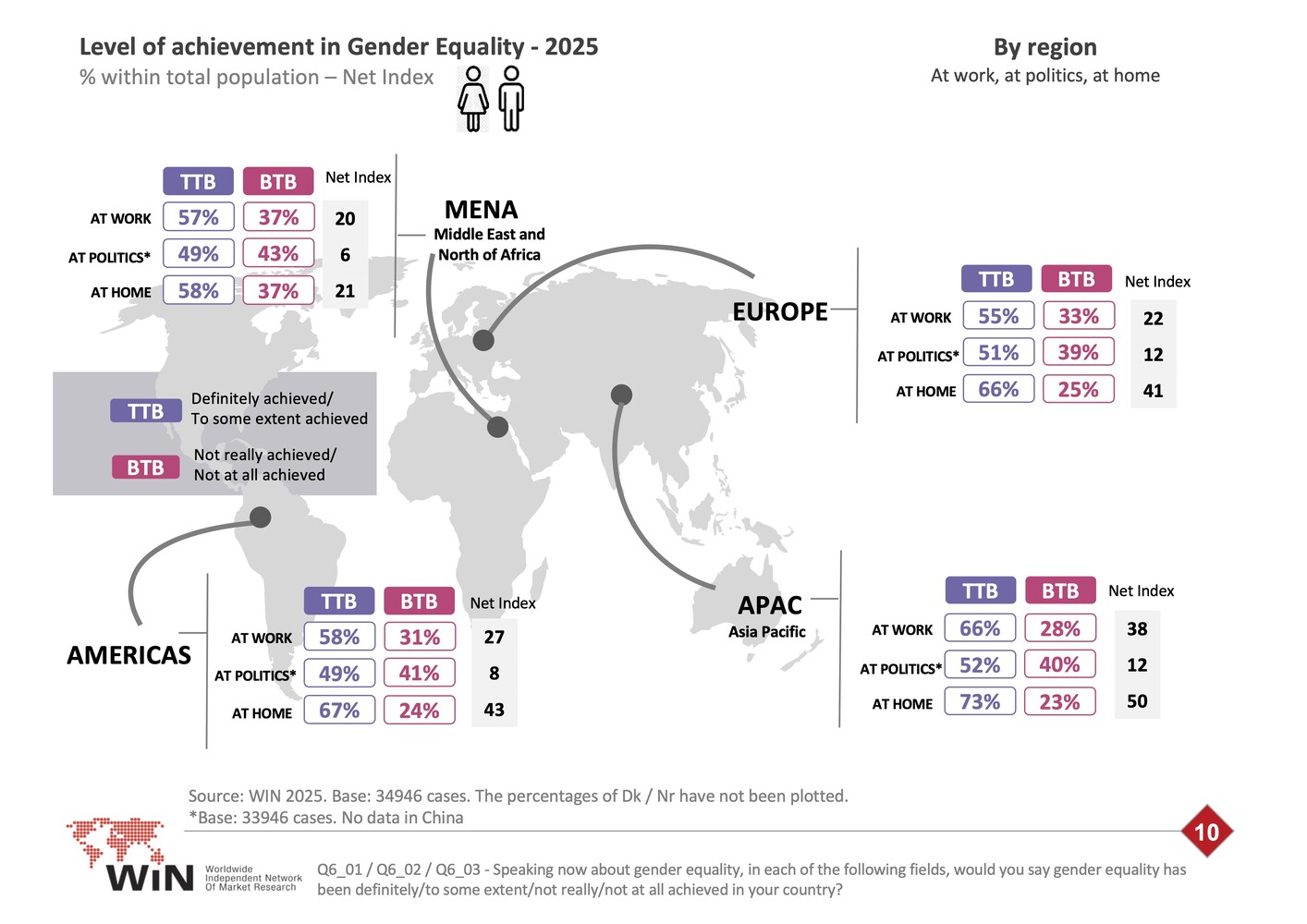
Globally, workplace gender equality is often viewed as more advanced than political representation, while home gender equality receives the highest ratings. However, this perception does not always match reality, as women in most regions still shoulder the majority of domestic responsibilities and encounter obstacles in leadership positions. |
 |
| |
|
Regional Differences in Gender Equality |
|
|
| |
- The Asia-Pacific (APAC) region leads in perceptions of gender equality in both the workplace and at home. 66% of respondents believe workplace equality has been achieved, while 73% believe the same for home life—both figures are above the global average. However, a high perception of equality does not necessarily mean that traditional gender roles have vanished. For instance, in countries like Vietnam and Thailand, home equality is rated highly, yet women still handle most household chores. This indicates that even small increases in male participation in household responsibilities can be seen as significant progress.
- In comparison, Europe and the Americas report slightly lower perceptions of workplace gender equality, at 55% and 58%, respectively. However, both regions have relatively high scores for home equality, with 66% in Europe and 67% in the Americas. Despite this, political representation remains a challenge, with only 51% in Europe and 49% in the Americas believing gender balance has been achieved. This points to slow progress in women's leadership roles despite the presence of strong institutional gender policies.
- Conversely, the Middle East and North Africa (MENA) have the lowest perceptions of gender equality across all categories, especially in politics (43%) and home life (58%). This indicates significant structural and cultural barriers that limit women’s opportunities for leadership and economic participation.
|
|
| |
| |
|
II. Workplace Gender Equality: Perception vs. Structural Barriers |
|
| |
Global Findings |
- Globally, 60% of respondents believe that gender equality has been achieved in the workplace, while 31% feel that barriers still exist. A notable trend is that men (65%) are more likely than women (55%) to believe that workplace gender equality is a reality, despite ongoing disparities in pay, leadership representation, and opportunities for career advancement.
|
China’s Reality |
- In China, perceptions of workplace equality are higher than the global average. A total of 68.7% of Chinese respondents believe that gender equality has been achieved in the workplace, which includes 16.5% who say it has been "definitely achieved" and 52.2% who feel it has been "achieved to some extent."
- Similar to the global trend, there is a gender gap in these perceptions. Men (72.1%) are more likely than women (64.3%) to assert that workplace equality has been achieved.
|
Understanding the Gap |
- While China has a relatively high perception of workplace equality, significant structural challenges still hinder women's career progression and representation in leadership roles. Although policies supporting workplace gender equality are in place, achieving true equality will require not only these policies but also fundamental cultural and structural changes within workplaces.
- Younger and lower-income respondents tend to be less optimistic about the existence of gender equality at work, indicating that while equality may be more visible at senior or higher-income levels, it is not fully experienced by entry-level workers.
- Additionally, cultural expectations around work-life balance disproportionately affect women, particularly in high-pressure industries like technology and finance, where long work hours complicate career advancement for those with family responsibilities.
|
|
| |
| |
|
III. Household Gender Equality: Cultural Norms Shape Perception |
|
|
| |
Global Findings |
- Worldwide, 69% of respondents believe that gender equality has been reached at home. However, the actual division of household labor contradicts this belief. Women continue to perform the majority of household chores, particularly cooking, laundry, and childcare. The only task that men consistently undertake more than women is taking out the trash.
|
China’s Reality |
- China reports a perception of gender equality at home that is even higher than the global average. According to recent data, 81.5% of respondents believe that equality has been achieved in their households, with 38.5% stating it has been "definitely achieved" and 43% saying it has been "achieved to some extent."
- In China, the distribution of household tasks reveals that women are still primarily responsible for the majority of chores, with 86% handling cooking compared to 75% of women globally, 82% taking care of laundry versus 67% globally, and 58% looking after children, while only 36% of women worldwide bear that responsibility. The only notable exception to this trend is in pet care, where men's involvement is nearly equal to that of women.
|
Why the Discrepancy? The Role of Cultural Expectations |
- There is a noticeable gap between perceived and actual equality in household responsibilities, which is also evident in other Asian cultures like Vietnam and Thailand. Despite high scores indicating home equality, women still bear most of the household labor.
- The primary reason for this discrepancy lies in cultural norms surrounding household duties. In societies where women have traditionally been responsible for housework, even small increases in male participation can be viewed as significant progress. Moreover, in urban middle-class families, many responsibilities are often outsourced to domestic helpers or grandparents. This can create an illusion of equality while not fundamentally altering gender roles.
- Achieving true equality at home will require not just a division of tasks, but also a change in how household labor is valued and distributed.
|
Globally, workplace gender equality is often viewed as more advanced than political representation, while home gender equality receives the highest ratings. However, this perception does not always match reality, as women in most regions still shoulder the majority of domestic responsibilities and encounter obstacles in leadership positions. |
| |
|
| |
| |
|
IV. Gender-Based Violence and Harassment: A Question of Reporting |
|
| |
China’s Reality |
- China has some of the lowest rates of gender-based violence and harassment in the world: 97% of women in China report not experiencing any form of violence (either physical or psychological) in the past year. Additionally, 98% of women state that they have never encountered sexual harassment.
|
Is This a Sign of Progress or Underreporting? |
- The figures suggest that women in China experience a relatively safe environment, but they also raise concerns about the underreporting of incidents. Social stigma and legal barriers may prevent women from reporting harassment or violence. Discussions about gender-based violence are sensitive, and high-profile cases of workplace misconduct and domestic violence often receive limited media attention and legal follow-up.
- While low reported rates could indicate real progress, they may also imply that women do not feel comfortable or empowered to report these incidents. Achieving true gender safety requires not only low rates of violence but also a legal and social environment where victims feel safe and supported in speaking out.
|
|
|
| |
| |
|
V. Moving Forward: Addressing Perception Gaps and Structural Barriers |
|
|
| |
-
The WIN Worldview Survey 2025 highlights the evolving gender landscape in China, where perceptions of progress coexist with ongoing gender imbalances both at work and at home. While workplace gender equality is perceived to be higher than the global average, women still face barriers to career advancement. Although there is a strong belief in household gender equality, women continue to handle the majority of housework. Additionally, while reports of gender-based violence are low, the possibility of underreporting may obscure the true extent of the issue.
|
| |
|
| |
|
What Needs to Change? |
|
| |
-
Workplaces must go beyond merely implementing policies; they need to actively dismantle cultural biases and remove career obstacles for women. Additionally, household gender roles should evolve beyond mere perceptions, ensuring equal participation in domestic labor. Stronger protections and increased social awareness of gender-based violence are essential to promote safe and stigma-free reporting. China's journey towards gender equality is ongoing, and true equality cannot be achieved through perception alone; it requires active, structural changes at all levels of society.
|
|
|
|
|