The next literacy challenge: Teaching students how to write |
|
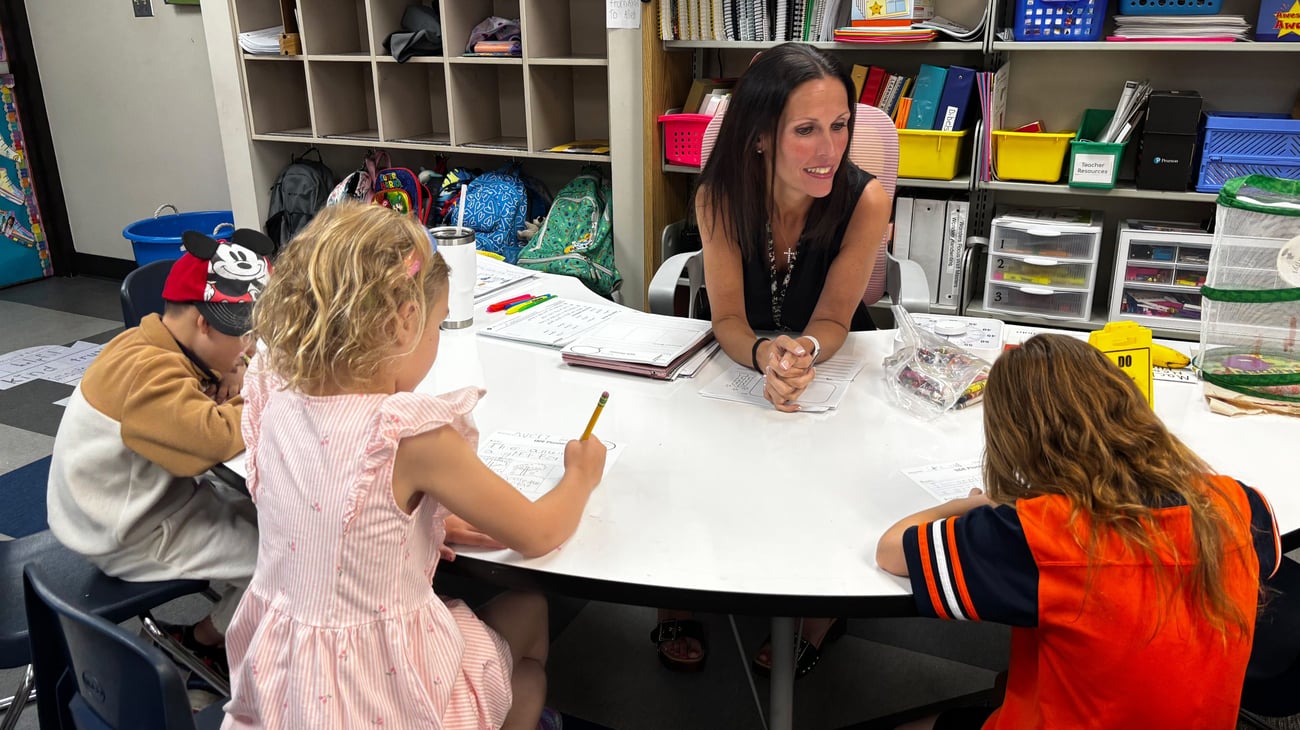
It was the middle of a writing lesson in Gabrielle Grace’s first grade class at Sand Creek Elementary in suburban Denver, and students were furiously jotting down details about their summer plans, the first step in composing a paragraph on the topic.
Except for 6-year-old Dean, who was already done.
“This stuff was just too easy for me,” he said. He pointed to his worksheet, fully filled out with a topic sentence (“I do many things over the summer”) and a list of his summer activities (“park, ipad and vacation”).
“I wrote this, like, before the bell rang,” he said nonchalantly.
At the beginning of the year, many of Grace’s students couldn’t write a sentence. “Now, they do this on their own,” she said. “Their writing is very organized. They write in complete sentences. It’s just like clockwork.”
Dean’s writing prowess — and confidence — is what many elementary school teachers dream of. For years, teachers have bemoaned the state of student writing — and have struggled to manage students’ complex, largely negative feelings about it. Across grade levels, educators say children struggle to write basic sentences, let alone use proper spelling and punctuation. In upper elementary grades, when students should be writing paragraphs and short essays, teachers are finding many students still lack fundamental skills and struggle to write at length.
In recent years, concerned by low writing scores on state exams, some districts have started to rethink how they’re teaching writing. For example, in the 61,000-student Douglas County district, administrators have added more professional development for teachers in evidence-based writing approaches and are prioritizing explicitly teaching writing to students. Similar efforts are underway in Tennessee, Pennsylvania, California and Rhode Island.
Many school leaders say they’re seeing promising results, indicating that America’s children can write better — if they have the right instruction.
|
| Read the story |
|
|
|
|
Could a public campus really close?
|
|
When Ulysses McCready was in fifth grade, a group of Southern Oregon University music students hauled instruments to Orchard Hill Elementary School to help get local kids excited about joining the middle school band. It worked on McCready, who picked up the flute and soon fell in love with music.
“That day I was like, ‘I am going to be in SOU’s music program one day,’ ” they said.
A decade-and-a-half later, McCready, now 26, transferred from a local community college to Southern Oregon, in Ashland, both because of that childhood exposure and because it’s the only four-year university in the region and they needed to stay close to their family.
But the university’s financial troubles have disrupted their first two years. They enrolled as a political science major and became fascinated with gender and women’s studies, only to see both programs be scheduled for phasing out. They joined the wind ensemble and pep band, only to see the music department placed on the chopping block this spring, as university leaders cut millions more dollars from the budget.
The school’s financial crisis has been a great source of stress for students, faculty, staff and area residents. McCready and other students said they are considering transferring to other schools.
Southern Oregon’s financial picture is that grim. The school has been struggling financially for years with decreasing enrollment and increasing costs. This year, a surprise $15 million hole in the budget — the result of an ineffective budgeting strategy and computer problems, officials say — meant that SOU couldn’t make payroll or pay the electric bill by Feb. 2027 without a bailout from the state. Without financial help and major cuts to the budget, this 150-year-old public university would have to close, its leaders said.
Across the country, financial pressures have battered many colleges, forcing some small private institutions and for-profit schools to close. Public colleges have also faced challenges, and some large systems have closed branch campuses or merged with other institutions. But Southern Oregon is one of the first public regional universities to face serious risk of closure. |
| Read the story |
|
|
|
|
|
|
|
When you sponsor a newsletter from The Hechinger Report, you reach educators, families and decision makers. Learn more from our sponsorship page or email [email protected]. |
|
|
Facing political attack and falling enrollment, colleges take the fight to … each other
|
|
|
|
Competition is intensifying among institutions and recruiters for a dwindling supply of students. |
|
|
|
|
|
|
|
|
|
|
|
|
|
|
|
|

 Support nonprofit news