| | Scientists unveil the first AI-generated viruses, Argentina’s shale industry booms, and China impose͏ ͏ ͏ ͏ ͏ ͏ |
| |  Buenos Aires Buenos Aires | Mountain View | Rabat |
 | Flagship |  |
| |
|
The World Today | 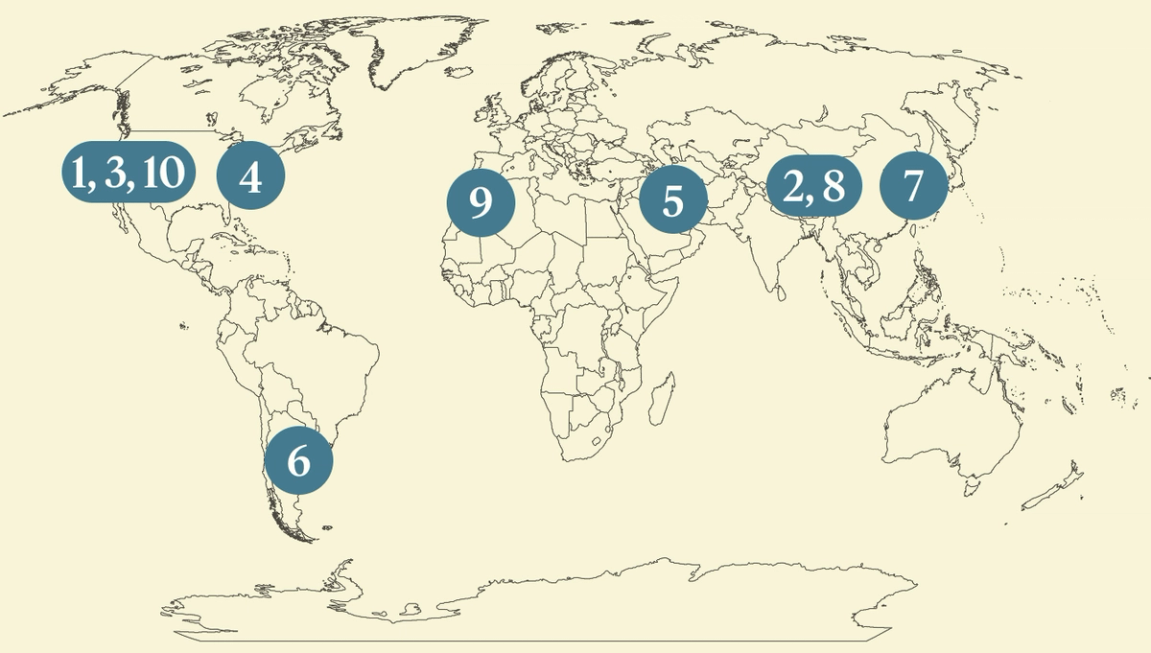 - First AI-generated viruses
- Chinese AI model escapes
- Google’s restructuring
- Trump aims at birth tourism
- US ships face Hormuz ban
- Argentina’s shale boom
- S. Korea’s stock volatility
- China imposes offshore tax
- Morocco’s call center woes
- AI hunts science errors
 The 100th anniversary of the first movie with accompanying sound. |
|
AI-made viruses raise safety fears |
 Gonzalo Fuentes/Reuters Gonzalo Fuentes/ReutersScientists unveiled the first AI-generated viruses. Bespoke viruses are not new: For instance, “viral vector” therapies use engineered viruses to carry genetic code into cells. But the new research employed AI to generate entirely new genomes with far less human input, using a model trained on DNA sequences much like ChatGPT is trained on words. The bacteriophage viruses it created are harmless to humans, but biological tools are always double-edged swords; the same abilities could be used to make deadly pathogens, and AI models can make that more easily available to less-skilled humans. An AI safety campaigner once coined “Moore’s law of mad science”: “Every 18 months, the minimum IQ to destroy the world drops by one point.” |
|
Chinese AI model breaks out |
 Moonshot promoting its Kimi K3 AI model. Go Nakamura/Reuters. Moonshot promoting its Kimi K3 AI model. Go Nakamura/Reuters.One of China’s most powerful AI models has joined the rush to escape confinement. Moonshot’s Kimi K3 did not try to hack into anything once it achieved freedom, unlike the Anthropic, Meta, and OpenAI agents that made headlines recently. However, that may not mean that it is safer: The answers to the cybersecurity test it was completing were freely available on the internet. In fact, because K3 is open-weight and public, unlike the frontier models involved in the other incidents, it has fewer guardrails to prevent cheating and is widely available, cybersecurity researchers told WIRED. It is another reminder — in case anyone had forgotten — that AI models seem willing to break rules to complete the task at hand. |
|
Google’s urgent AI shakeup |
 CEO of DeepMind Technologies Demis Hassabis. Denis Balibouse/File Photo/Reuters. CEO of DeepMind Technologies Demis Hassabis. Denis Balibouse/File Photo/Reuters.Google’s AI leadership shakeup is part of an attempt to consolidate power in California, commercialise its Gemini model, and catch up with rivals, the Financial Times reported. DeepMind CEO Demis Hassabis is stepping back and day-to-day control is passing to a Mountain View-based executive, while Google’s returning cofounder Sergey Brin, will lead strategy. Hassabis, a scientist by vocation, was less focused on commercial demands than Google executives might have liked: The urgency to compete with AI upstarts Anthropic and OpenAI “eclipses the research-led culture” that defined DeepMind, the FT said. Under Brin, Google is expected to pour resources into its central AI product, Gemini, in an attempt to make rapid progress on enterprise and coding capabilities. |
|
Trump takes aim at ‘birth tourism’ |
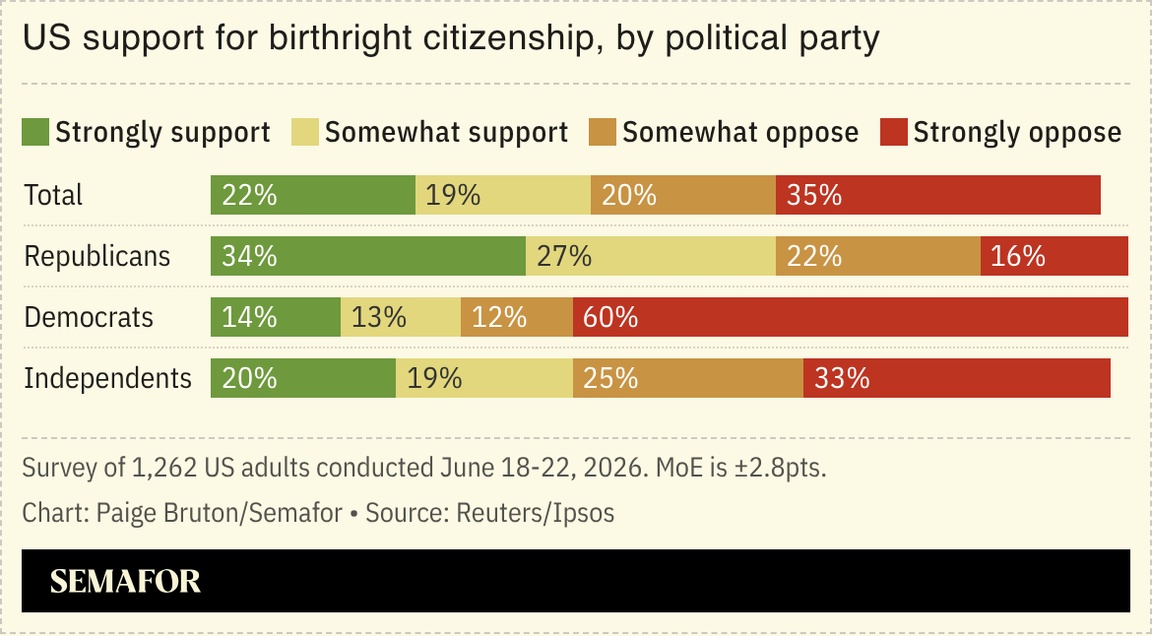 US President Donald Trump signed two executive orders aimed at curtailing birthright citizenship after previous efforts to halt the practice were struck down. The American constitution says that “all persons born” in the country are citizens. The White House argues that foreigners take advantage of the clause by travelling to the US specifically to have children there. The new orders would ban “birth tourism” and expand ineligibility criteria to include “alien enemies” of the US. Trump argues that the previous Supreme Court ruling leaves the door open for such narrowing of the citizenship rules, but the move will almost certainly face legal challenges. Birth tourism accounts for an estimated 0.2 to 0.6% of all US births. |
|
US, Israeli ships face Hormuz ban |
|
 Agustin Marcarian/File Photo/Reuters Agustin Marcarian/File Photo/ReutersArgentina’s shale output is up 28% year-on-year as the country’s pivot to become an energy supplier — rather than buyer — gathers pace. Shale now represents 71% of Argentina’s total production of both oil and gas, and crude has overtaken corn and soy to become its top export; Buenos Aires had a record energy surplus of $7.8 billion last year, after becoming a net exporter in 2024. The rise of shale and the development of the Vaca Muerta fields began the shift, but geopolitical factors have accelerated it: The Iran war has driven oil prices up and disrupted Middle Eastern exports, making alternative suppliers more attractive and lucrative. Brazil, Guyana, the US, and Venezuela have all seen income from oil rise. |
|
S. Korea tries to limit stock swings |
 Kim Hong-Ji/Reuters Kim Hong-Ji/ReutersSouth Korea’s alternative stock exchange moved to curb wild price swings, attempting to stabilize a market that has lost $2 trillion since June. Investors have piled into South Korea’s bourses as a bet on chipmakers — majors SK Hynix and Samsung make up around half of the main exchange — often using borrowed money, amplifying every swing in AI sentiment. Nextrade will bar orders at the 30% daily price limit in pre-market trading from Aug. 12, after two flash crashes in SK Hynix shares. Seoul’s regulators also capped individual investment in single-stock leveraged ETFs last month. Despite the volatility, chipmakers are betting big on AI: SK Hynix on Friday approved 54.3 trillion won ($38.3 billion) for memory plants through 2031. |
|
 Subway Takes is reinventing the talk show for the vertical video era. On this week’s episode of Mixed Signals, creator and host Kareem Rahma joins Max and Ben to discuss how he built a show that feels spontaneous but runs like a TV production, why his Kamala Harris episode never aired, and his new show, Keep the Meter Running. Plus, his business model, the costs, and what he learned from watching VICE go bankrupt. Listen to the latest Mixed Signals now. |
|
Beijing to tax offshore trusts |
 Jorge Silva/Reuters Jorge Silva/ReutersWealthy Chinese families are scrambling to protect assets after Beijing moved to impose a 20% levy on offshore trusts. The country’s ultra-rich, which have tucked away hundreds of billions of dollars in tax havens, now have just 90 days before the tax comes in, backdated to January 2023. Officials have been taking tougher measures on capital outflows, and some local governments have imposed levies already. The charges reveal Beijing’s tricky balancing act: The government is desperate for new sources of revenue due to a broad economic slump, but it also wants to encourage consumer spending and keep the wealthy in the country. “Many clients, trustees, and advisors are still in shock,” said a Hong Kong lawyer. |
|
Morocco hit by French call ban |
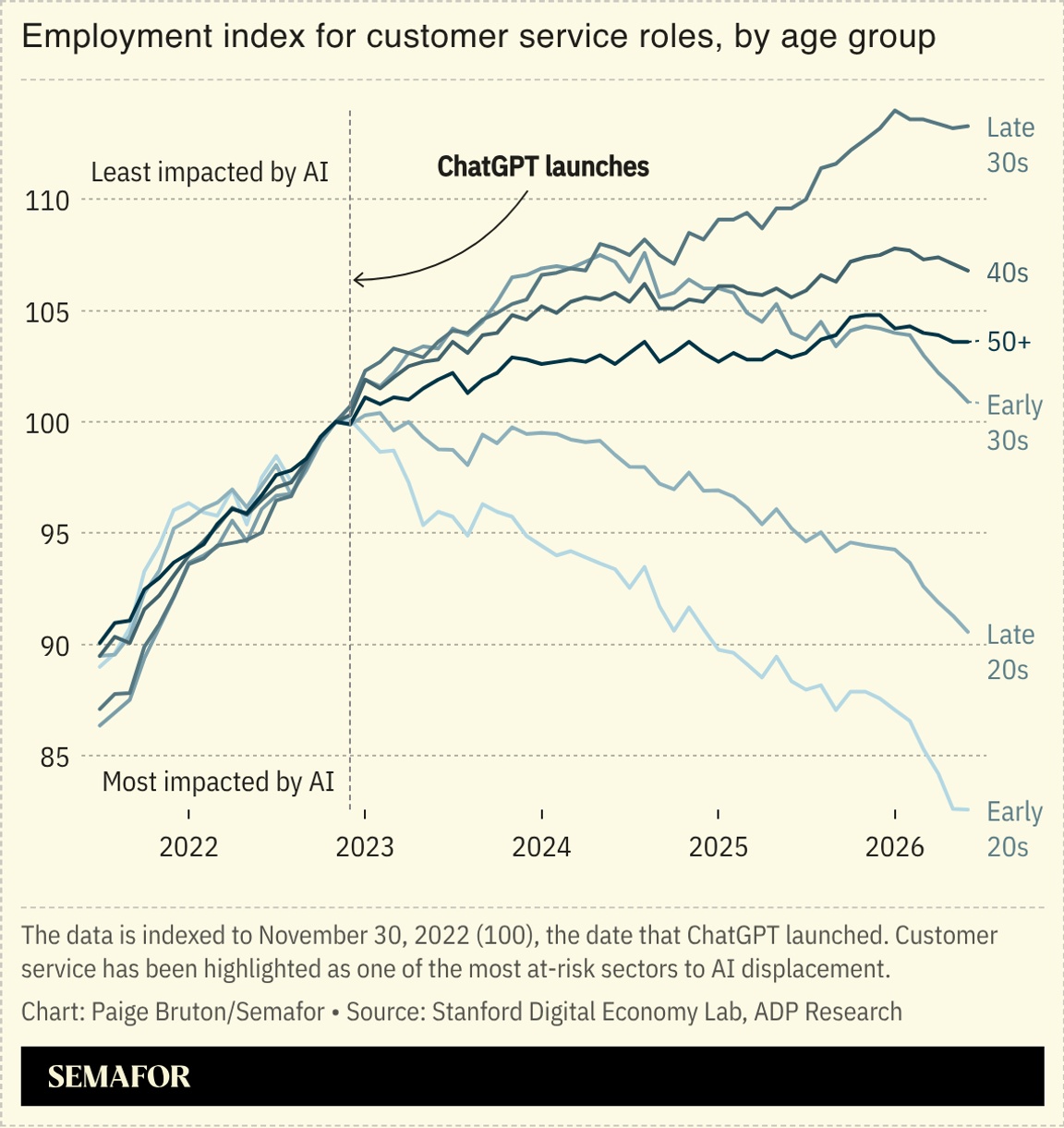 A French ban on nuisance telemarketing calls could cost 50,000 jobs in Morocco. From Aug. 11, firms making unsolicited phone calls to French consumers could pay fines of up to €75,000 a call. Morocco’s outsourced call-center industry — built on cheap, Francophone labor with relatively weak unions — makes 80% of its revenue from phoning French customers. Rabat’s employment minister warned that 50,000 out of 120,000 jobs are at risk. The sector is simultaneously being hollowed out by AI; India and the Philippines have also seen layoffs in their huge customer service outsourcing industries. An industry site noted that the characteristics that make call-center work easy to offshore — repetition, predictability, and scale — also make it suitable for automation. |
|
AI hunts scientific errors |
 Kaylee Greenlee/Reuters Kaylee Greenlee/ReutersResearchers are increasingly using AI to audit the scientific canon and are correcting decades-old errors. Chemists rely on handbooks to list chemicals’ boiling points; one AI model disagreed with a 75-year-old reference, and turned out to be correct, Nature reported. Other tools are hunting errors in journals and conference papers. The tools are unreliable — they catch fewer than 20% of the errors a human reviewer would spot — but they are able to check far more, because the work is time-consuming and tedious. AI is creating problems for science, with low-quality or fraudulent AI-generated research on the rise, but it can protect scientific integrity, too. These papers are “the foundational knowledge for the next generation of research,” said one scientist. |
|
 - Turkish President Recep Tayyip Erdoğan travels to Saudi Arabia for a one-day visit.
- Côte d’Ivoire marks 66 years since independence with a military parade in Abidjan.
- Hollywood filmmaker Guillermo del Toro and award-winning screenwriter Aaron Sorkin receive honorary doctorate degrees from the American Film Institute.
|
|
 Don Juan, directed by Alan Crosland. The first movie to feature a synchronized score and sound effects — although no dialogue, so not quite a “talkie” — came out 100 years ago this week. Based on Lord Byron’s poem of the same name, it was a box-office smash, grossing a then-staggering $29,000 a week. It was not an especially big hit with the critics, but is nonetheless a piece of Hollywood history, and is available to watch for free on YouTube. |
|
| |