| | Trump hails the ‘perimeters’ of a deal with Iran, China’s AI giants slash prices, and a Venezuelan o͏ ͏ ͏ ͏ ͏ ͏ |
| |  London London | Los Angeles | Tehran |
 | Flagship |  |
| |
|
The World Today | 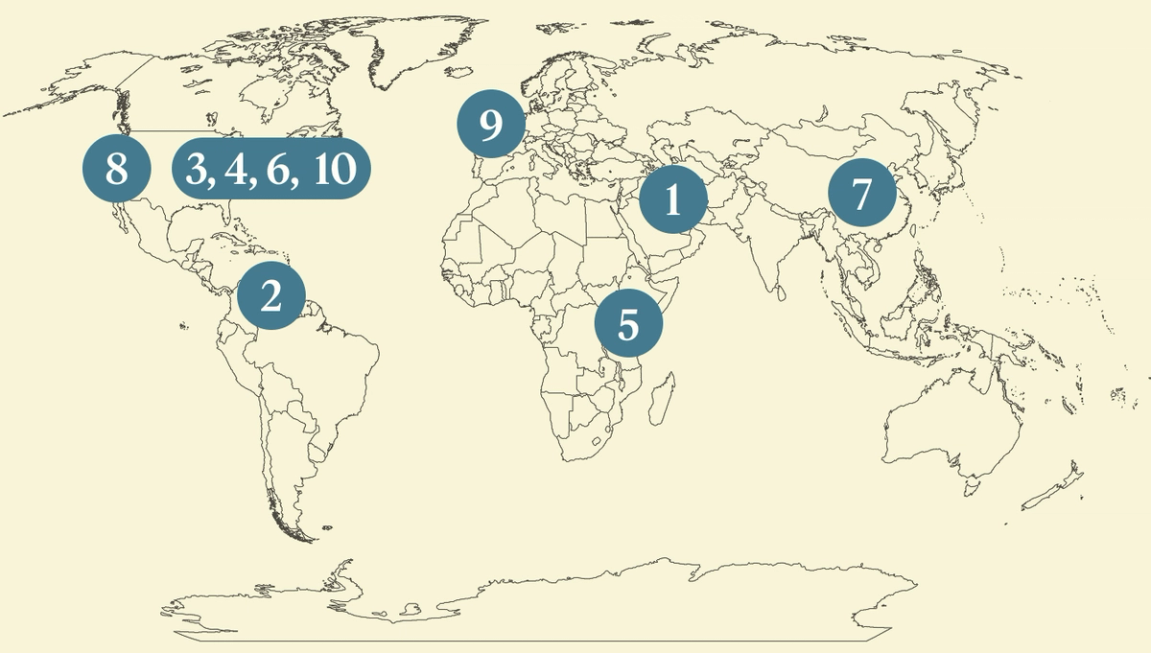 - Trump hints at Iran deal
- Venezuela oil rush begins
- Blanche scraps ‘slush fund’
- RFK backs measles vaccine
- Africa’s megaprojects era
- Strong quarter for Detroit
- China’s AI price battles
- Hollywood’s quiet AI boom
- European drought worsens
- First exomoon spotted
 The London Review of Substacks, and an autobiography by one of World War I’s most celebrated poets. |
|
Trump heralds ‘perimeters’ of a deal |
 Daniel Heuer/Reuters Daniel Heuer/ReutersUS President Donald Trump called off threatened strikes on Iran, saying the “perimeters of a deal” were in place, sending oil prices tumbling 5%. Iranian diplomats reacted positively to a plan presented by Qatari mediators to restore traffic through the Strait of Hormuz, which usually carries 20% of the world’s oil, The Wall Street Journal reported. But the Saudi crown prince reportedly pressed Trump to hold off signing: Gulf states now hold more sway with the president than Israel, one former Israeli intelligence official argued. Five months of oscillation between bombing and negotiation have left Trump with no good options. “He’s looking for a knockout blow when there is none,” one analyst told The New York Times. |
|
Venezuela’s black gold rush begins |
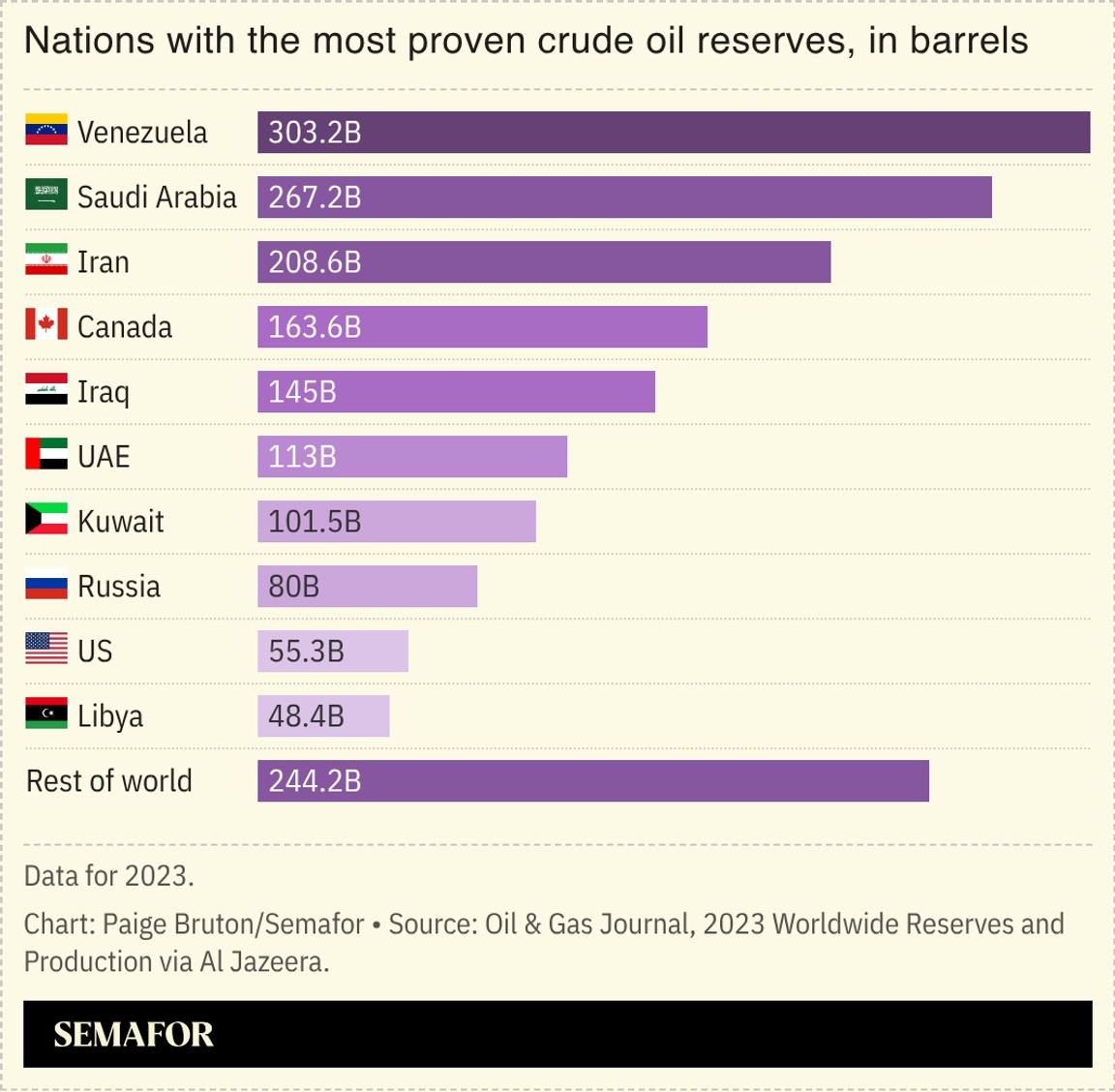 Foreign oil companies and investors are moving into Venezuela seven months after the US toppled then-President Nicolás Maduro, betting the world’s largest crude reserves are finally open for business. Acting President Delcy Rodríguez has scrapped the rule requiring state-run PDVSA to hold majority stakes in joint ventures, allowing private firms to operate fields directly and keep more of the profit, while Washington has unwound sanctions to ease access to Venezuela’s 300 billion barrels. But the skeptics have long memories: ExxonMobil, expelled in 2007 when its assets were expropriated, dismissed the country as “uninvestable” as recently as January. Kpler, meanwhile, cautioned that new projects will take five years and colossal sums to deliver results from an industry hollowed out by underinvestment. |
|
Blanche scraps ‘slush fund’ plans |
 US Acting Attorney General Todd Blanche. Nathan Howard/Pool/Reuters. US Acting Attorney General Todd Blanche. Nathan Howard/Pool/Reuters.Acting US Attorney General Todd Blanche rescinded plans for a controversial $1.8 billion “slush fund,” smoothing his path to permanent appointment but underlining President Donald Trump’s weakening grip on his party. The Anti-Weaponization Fund would have barred tax investigations into Trump’s family and compensated allies for prosecutions. The plan faced widespread opposition and two outgoing GOP senators said they would vote against Blanche’s appointment in protest. Although Trump had threatened to keep him on in an acting capacity, the formal rescindment “establishes, beyond any doubt,” that the bill is dead. The two holdouts were regular defectors, but Trump’s relationship with his party, especially in the House of Representatives, is strained. “We are knifing each other,” one senator told CNN. |
|
Kennedy’s U-turn on measles vaccine |
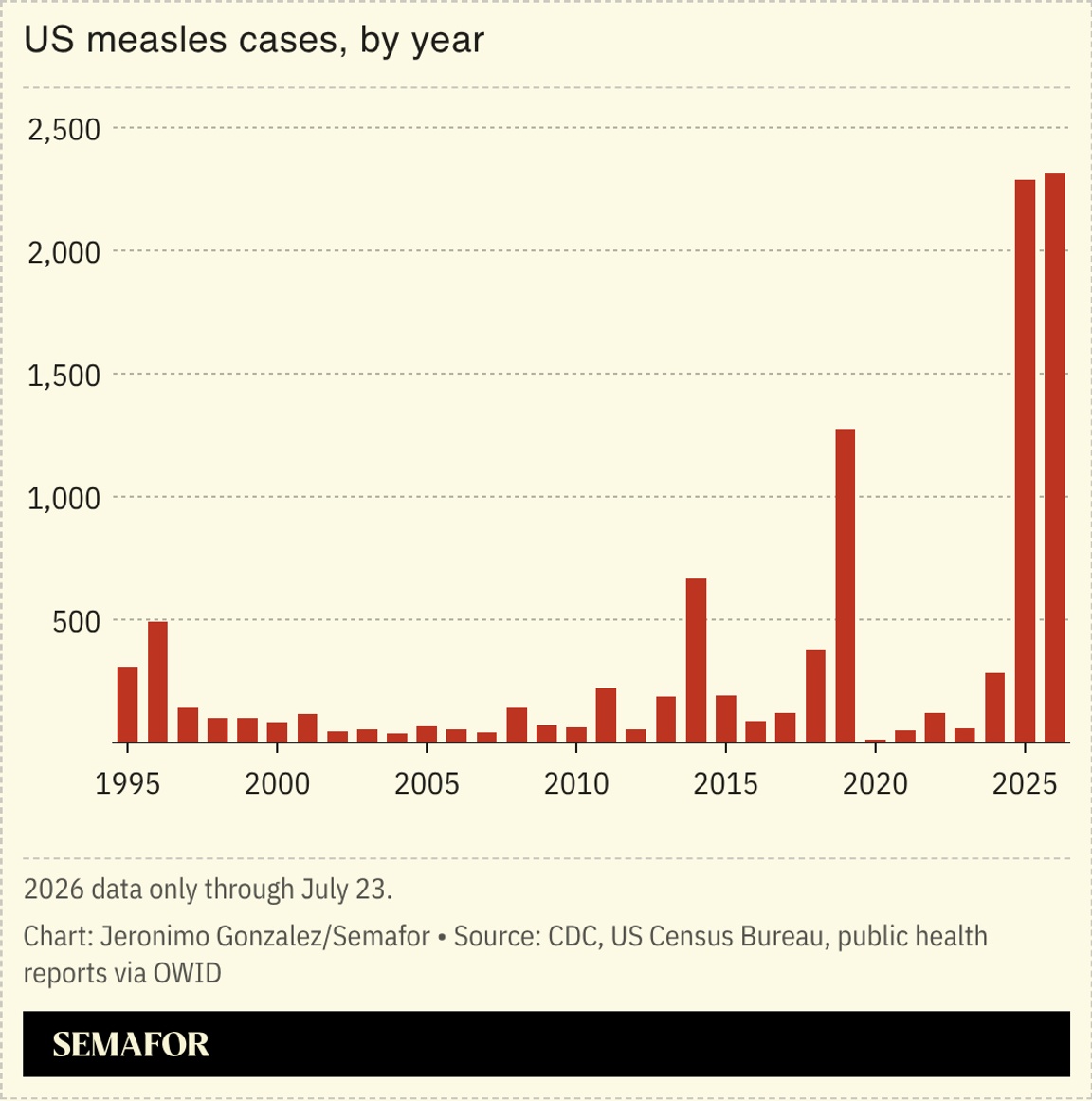 US Health Secretary Robert F. Kennedy Jr. encouraged parents to get their children vaccinated against measles, as the worst outbreak for decades gripped the country. The 2,371 confirmed cases this year have already surpassed 2025’s total, and the two years together have cumulatively seen more infections than the rest of the 21st century combined, The Guardian noted. Kennedy, a longtime vaccine skeptic, has attempted to reduce childhood vaccination schedules and suggested the MMR vaccine could cause autism as recently as November — a claim unsupported by evidence — but shifted stance in a bad-tempered interview on CNN. “I’ve never questioned the efficacy of the MMR vaccine,” he said. |
|
Africa’s new era of megaprojects |
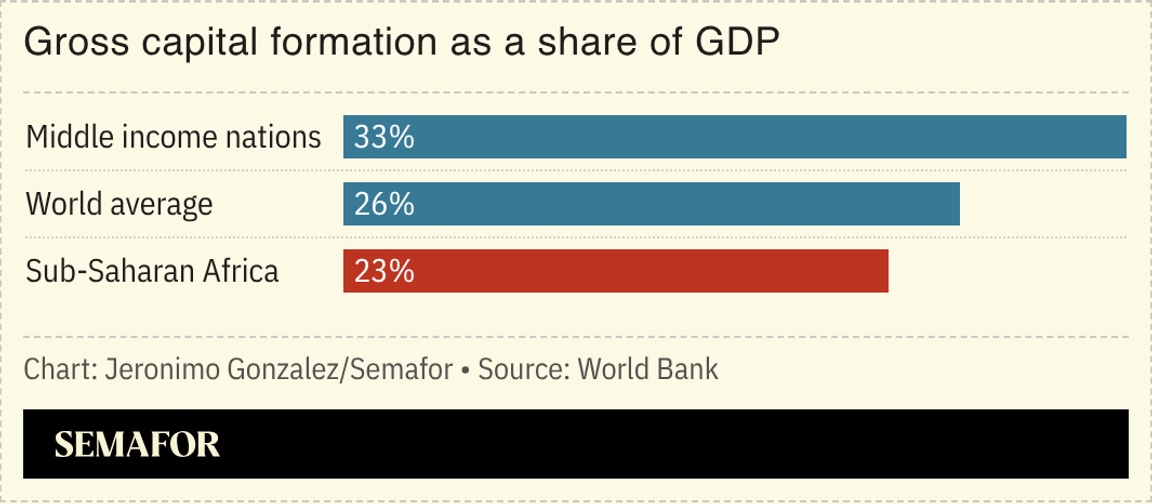 African nations are building major infrastructure projects at an unprecedented rate in a bid to boost energy independence and improve logistics, though commentators warn that soaring debt levels may hamper progress. The war in the Middle East, which supplies a vast amount of Africa’s fuels, exposed the continent’s reliance on energy imports, accelerating efforts to build new refineries and pipelines. Competition between China and the US for influence over the region has also brought in billions in infrastructure investment, ushering in a new era of “megaprojects.” However, rising debt payments and aid cuts are squeezing the public finances of many African countries. Though that doesn’t mean projects are “doomed,” The Economist argued, “ambition alone… will never be enough.” |
|
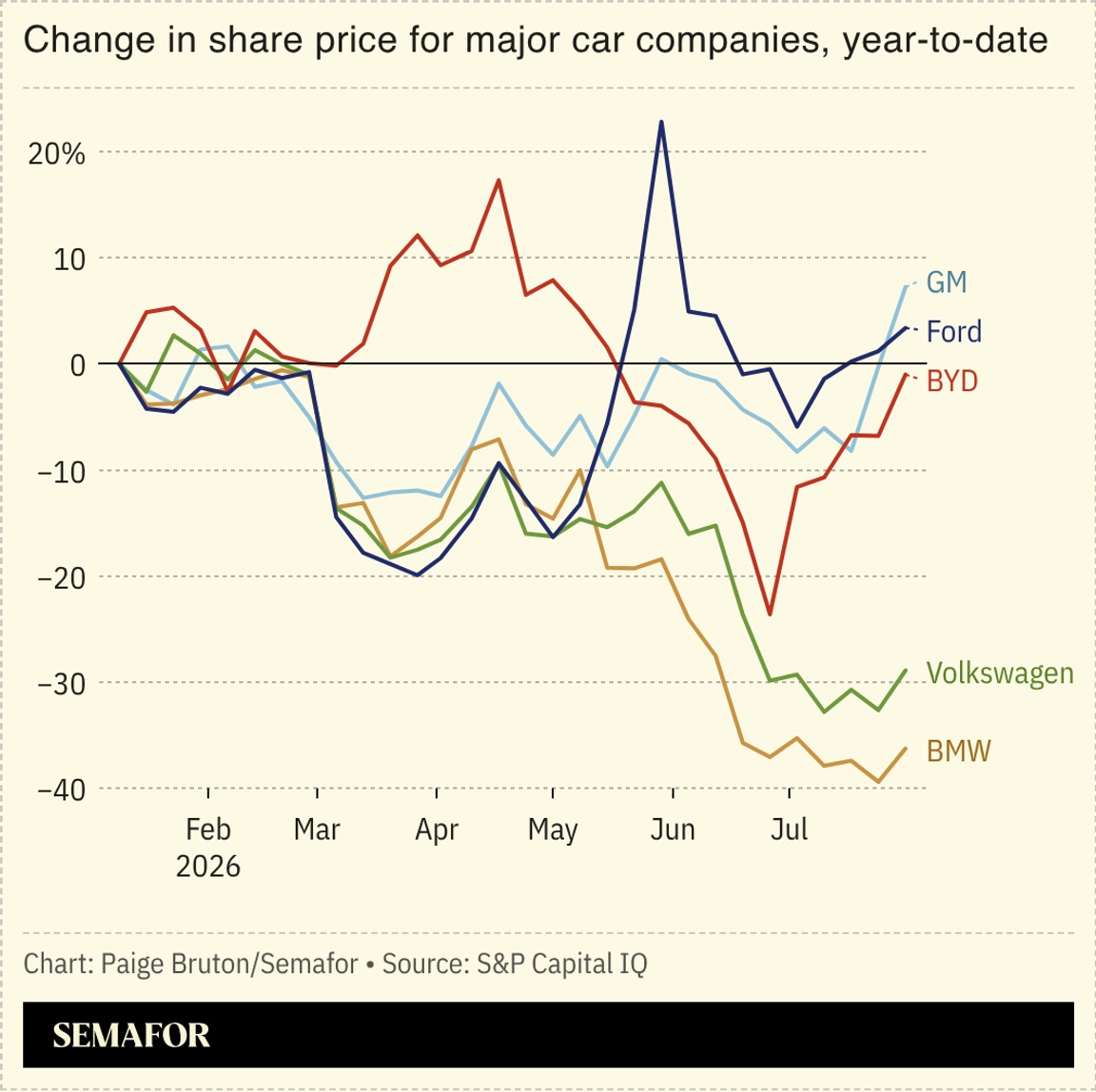 US carmakers had a strong quarter, with Americans’ demand for gasoline-powered SUVs and trucks boosting Detroit’s profits, in contrast to European rivals. Ford, GM, and Stellantis all benefited from Washington slashing emission standards and EV promotions, plus tariffs on Chinese products protecting them from cheap EV imports. But Germany’s BMW, Mercedes-Benz, and Volkswagen all warned of lower-than-expected profits, hitting shares. The EU has stricter emissions rules, which carmakers say add to costs. They also want the bloc to strengthen defences against BYD and other Chinese EV giants, which now account for nearly 10% of the continent’s car market. Much of Asia is seeing an EV boom too, as government incentives and competition among Chinese manufacturers drive prices down. |
|
AI giant DeepSeek’s deep cuts |
|
Hollywood quietly adopts AI |
 Daniel Cole/Reuters Daniel Cole/ReutersMore than 10% of Hollywood job adverts are AI-related, The Los Angeles Times reported, suggesting the US movie industry is increasingly incorporating the technology despite public protests. AI use was a driver of the 2023 writers’ and actors’ strikes, and consumers are skeptical, so studios “never talk about it in public,” an industry executive told the paper. But Netflix is advertising for “Manager, Generative Workflows,” and Disney and Amazon have similar postings. Big stars including Ben Affleck and Martin Scorsese are backing AI firms: George Lucas said rejecting it was like picking a horse and buggy over a car. It is Hollywood’s “new cosmetic surgery,” The LA Times said: “Everyone knows it is happening, but few will admit to it.” |
|
London’s first dry month in 150 years |
 Isabel Infantes/Reuters Isabel Infantes/ReutersLondon’s Kew Gardens, home to a weather station since 1871, recorded its first calendar month with no rain in 155 years. Europe is struggling with a continent-wide drought: Record low water levels in the Danube river have forced Hungary to shut down its only nuclear power plant, and the government is preparing for blackouts and electricity rationing at a time when the country’s economy is struggling. Romania’s Cernavodă plant, also on the Danube, has already shut down and the Rhine’s water shortage has disrupted German trade. Though London’s first-ever rain-free month is not confirmed, there is no end in sight: forecasters said there was “little sign of the widespread, sustained rainfall that would be needed” to end the UK’s drought. |
|
First time exomoon detected |
 The Deep Field South observed by the Euclid space telescope. European Space Agency//Euclid Consortium/NASA, image processing by JC Cuillandre, E. Bertin, G. Anselmi/Handout via Reuters. The Deep Field South observed by the Euclid space telescope. European Space Agency//Euclid Consortium/NASA, image processing by JC Cuillandre, E. Bertin, G. Anselmi/Handout via Reuters.Astronomers detected a — massive — moon in an alien star system for the first time. Until 1992, there was no direct proof that other stars had planets, but improved telescopes have now spotted more than 6,000, usually by noticing stars briefly dim as the planet occludes them. Until recently they had not detected moons, which usually are far smaller. The new discovery uses a different technique, observing stars being wobbled by other bodies’ gravity. It also helped that the exomoon in question was very, very large: It is orbiting a “brown dwarf,” an object bigger than the biggest planets but too small to become a star, and is itself almost as big as Jupiter. |
|
 - Argentinians launch a nationwide strike over low wages and the dismantling of state agencies, which has led to the loss of public sector jobs.
- SpaceX releases its first earnings report after its record-breaking IPO in June.
- The opening rounds of the Canadian Open continue in Montreal and Toronto.
|
|
 Their money tips her scales again New York Mayor Zoran Mamdani recently unveiled plans for five city-run grocery stores, with prices of staples like meat, milk, and bread pegged to 30% below retail prices. While this may sound positive, the academic Daniel Muñoz writes that it is an example of the road to hell being paved with good intentions. “Mamdani’s stores are not just cutting their prices by being efficient,” he says, they are using tax dollars to beat the prices of local bodegas and grocers, so those rivals cannot compete. Even if existing outlets cut prices, the new ones will undercut them, because they’re pegged to 70% of market rate. What it will mean, he says, is lines. If a store is 30% cheaper, people will queue up there. That’d be fine if the stores were profitable: They’d make lots of money, open new stores, and hey presto, lines go down. But these stores are taxpayer-subsidized, so they can afford to run at a loss. The stores are “profoundly negative sum” — they destroy economic value to redistribute wealth. Progressive redistribution has benefits, but these stores are badly designed for it: Anyone can use them, with no means-testing. If you want to help the poor, Muñoz argues, food stamps work, “and they don’t cause long lines or put more efficient grocers out of business.” Life it seems will fade away There are lots of jurisdictions worldwide with assisted dying laws. But even in those places, they are rarely used. The Netherlands have some of the most longstanding and least restrictive rules, and still only 6% of deaths are assisted. Belgium it’s 4%, Switzerland barely 2%, and most other places, less than 1%. Why, the neuroscientist Ariel Zeleznikow-Johnston asks, do so few people choose it? After all, slow deaths are often horrible: “Bone riddled with cancer crumbles under ordinary weight. A tumor blocking the bowel means food has nowhere to go, so it comes back up.” Weeks and months can go by, a “slow loss of the self,” and “none of this is the worst case — it is roughly the ordinary one.” Whether or not assisted dying is moral, Zeleznikow-Johnston wants to know how many would opt for it if they had a real choice? At the moment, there are obstacles: Alzheimer’s patients rarely get the option, because most places require having a sound mind at the point of death; in some jurisdictions, only self-administration is allowed, and patients who are too weak to take the drugs cannot get help; in others, it is only available in a few major cities, and rural people too ill to travel cannot access the service. If those hoops were removed, he wonders, would “the number stay nearer today’s maximum of 6%, or eventually settle closer to 60%?” Rover, wanderer, nomad, vagabond Sam Kahn is a digital nomad. A few years ago, he’d have just been an expat, which had “a tawdry glamor to it,” but smartphones, Zoom, and reliable WiFi mean he can now live essentially as he did in New York, except in Bishkek, Kyrgyzstan. It’s nice having a developed-world salary with developing-world outgoings, but what interests him most, he writes in Persuasion, is what is similar, and what is different. He teaches journalism, and his students speak English and stare at their smartphones like back home: “The world really has gotten very small and, in many ways, very homogenous.” You can’t go much further from the US than Kyrgyzstan, and yet daily life, he says, is very familiar. But “this cultural homogenization has limits.” Where the West is centred on nuclear families, with public life run by institutions, Kyrgyzstan is clannish. Nepotism is frowned upon in the West, but in Kyrgyzstan, jobs are usually handed out via interpersonal relationships. There is less trust in administration and more loyalty to the personal network. The flip side of that, though, is that family structures are immensely strong: Households are large and multigenerational, and “family is the priority in a way that it simply isn’t” back home. There is a “great sorrow [in] how that has passed away from the West.” |
|
 Good-Bye to All That by Robert Graves. Graves is best known for his historical novels I, Claudius and Claudius the God, set in imperial Rome. But before that, he was best known for his writing about World War I. He was badly wounded at Loos and, alongside Wilfred Owen and his close friend Siegfried Sassoon, was a key part of the conflict’s efflorescence of anti-war poetry. This autobiography of Graves’ youth remains one of the greatest accounts of the war; unsentimental, often comic, but unflinching in its portrayal of battle and of postwar trauma. Buy Good-Bye to All That from your local bookstore. |
|
| |



