| | Oil prices drop after a pause in Gulf hostilities, Russia cancels its navy parade, CXMT stocks surge͏ ͏ ͏ ͏ ͏ ͏ |
| |  Buenos Aires Buenos Aires |  Bamako Bamako | Moscow |
 | Flagship |  |
| |
|
The World Today | 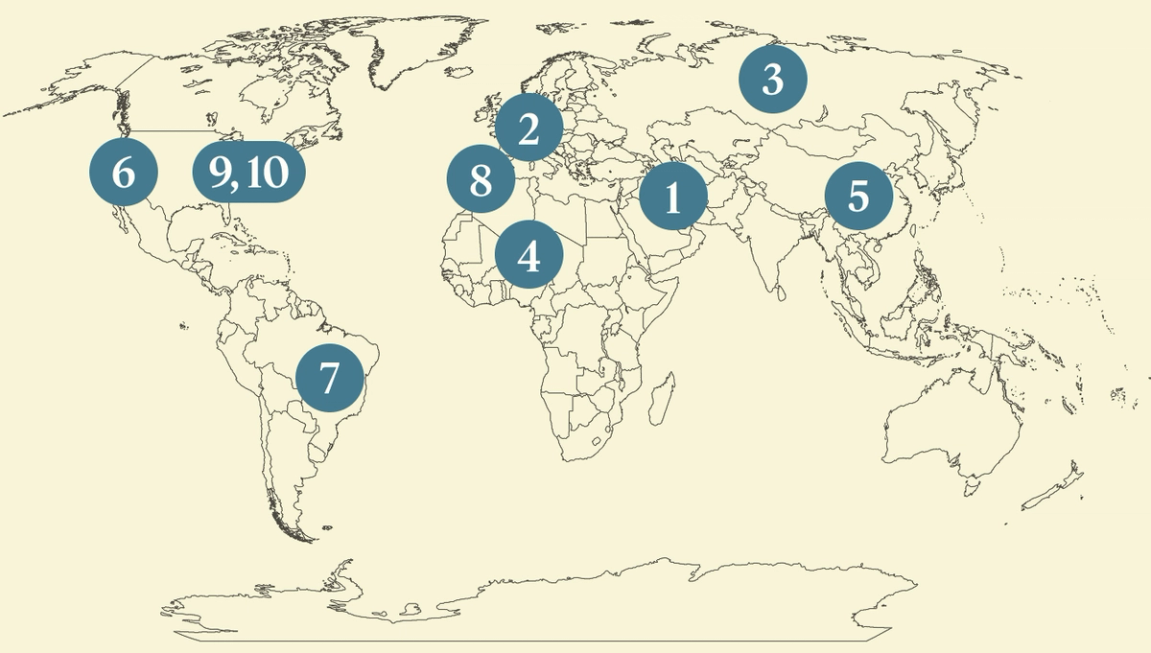 - Oil drops on Iran pause
- Arms giants buy startups
- Russia cancels navy parade
- Sahel juntas join forces
- CXMT surges at IPO
- Nvidia’s $250B OpenAI bet
- Lula, Milei trade barbs
- Europe races to tame fires
- Pressure on pension funds
- US cities losing children
 The London Review of Substacks, and the memoir of a Tour de France domestique. |
|
Defense giants turn to startups |
 Jeremy Lock/Reuters Jeremy Lock/ReutersThe world’s largest defense companies are investing in military startups at record rates. Giants such as BAE Systems and Lockheed Martin have piled $4.1 billion into venture capital rounds this year as they race to adapt to the rapid evolution of war, the Financial Times reported. The model is reminiscent of the pharmaceutical industry, in which incumbents — capital-rich but slow-moving — purchase innovation from smaller, more nimble rivals. Europe in particular, with two wars on its doorstep, is stepping up spending: EU governments are expected to shell out €454 billion this year, more than double 2021’s figure, Goldman Sachs said in a note. Deutsche Bank upgraded the French aerospace company Thales to a buy, suggesting investment would continue. |
|
Russia cancels navy parade |
 Stringer/Reuters Stringer/ReutersRussia canceled its annual St Petersburg Navy Day parade for the second straight year because of the threat of Ukrainian drone attacks. Kyiv’s long-range strike capabilities are increasingly hurting Russia far from the front lines: Moscow’s Victory Day parade in Red Square in May was significantly scaled back because of the possibility of attacks, St Petersburg’s oil terminal was damaged during a showpiece economic forum in June, and an e-commerce logistics hub in the same city came under fire last week. Attacks on oil refineries have caused a fuel crisis, with gasoline sales volume down 47% and prices up 45% since the start of the year, according to Meduza. |
|
Sahel militaries plan troop surge |
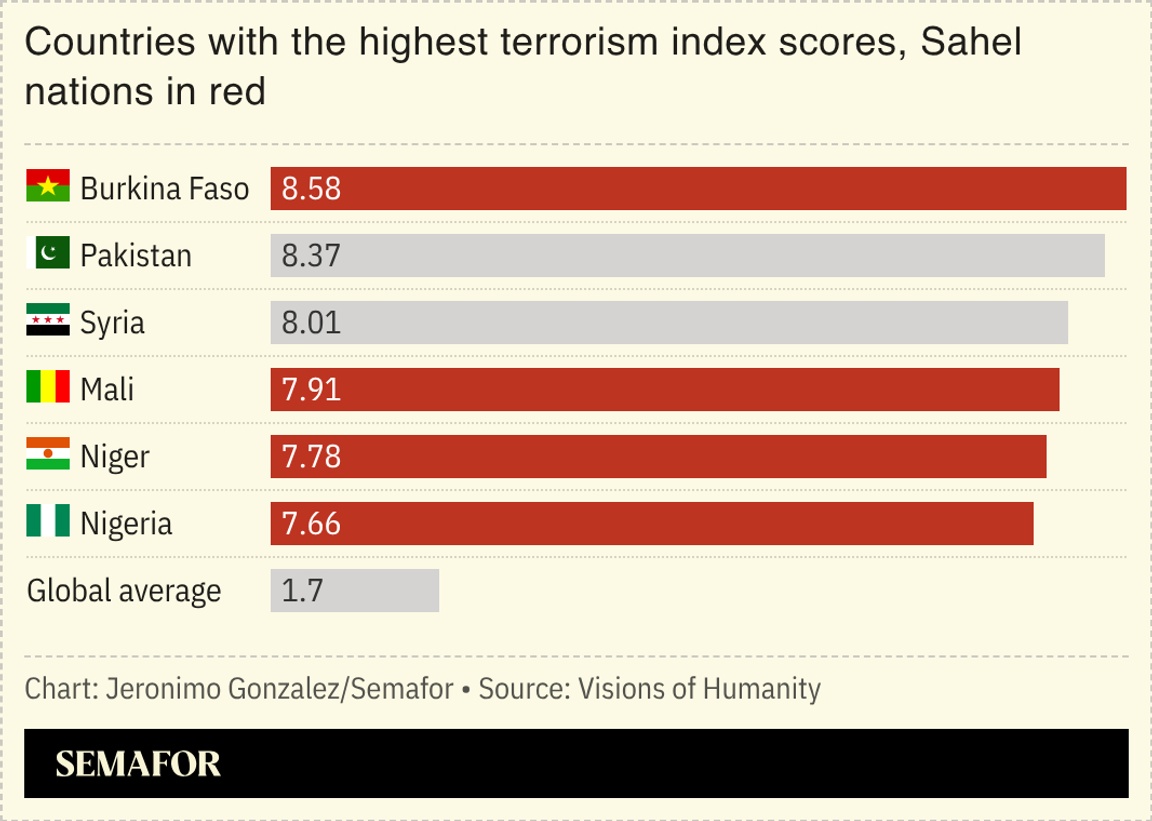 The three military-led governments in the Sahel region plan to triple their joint force to 18,000 troops as they look to combat Islamist insurgencies that have turned the region into the world’s terrorism hotspot. Chad, Mali, and Niger all recently broke defense ties with former Western allies and replaced them with Russia’s Africa Corps, a group that experts say helps to prop up African autocrats in exchange for economic concessions. However, the security situation in the Sahel has worsened significantly since the shift. With Russia focusing its military capabilities on the war in Ukraine, Moscow has deployed less-precise Iranian Shahed drones in its African operations, investigative outlet Bellingcat found. |
|
 Stocks in Chinese memory-chip giant CXMT jumped 466% in their debut, making it the country’s most valuable publicly listed firm and underscoring investors’ appetite for the companies underpinning the AI boom. CXMT has recently emerged as Beijing’s best hope of challenging foreign producers of memory chips, a key component in smartphones and AI servers, Bloomberg reported. The broader shortage has lifted chip companies worldwide — Micron reported a 15-fold increase in quarterly profits last month — while forcing retailers to hike prices for cars and mobile phones, among others. Though some analysts see the stock surges as overblown, others believe the furor is justified given forecasts that the memory crunch could last years. |
|
Plans for massive AI data center |
 Jonathan Ernst/Reuters Jonathan Ernst/ReutersNvidia is in talks to provide a $250 billion backstop for OpenAI’s lease of a data-center project, as AI hyperscaling intensifies despite market unease. The 10-gigawatt development — the largest data center announced so far — will be on US federal land and will have its power needs guaranteed by Washington, which the tech giants hope will circumvent permitting headaches and local opposition. Jittery investors, who have already driven a major selloff over concerns about Big Tech’s huge AI spending, will be eyeing earnings reports from several giants this week, The Information’s co-executive editor wrote. Of particular interest will be Meta and Microsoft, whose shares are down 9.8% and 21% respectively this year. |
|
Brazil and Argentina trade barbs |
 Argentinian President Javier Milei with Brazilian Senator Flávio Bolsonaro. Jean Carniel/Reuters. Argentinian President Javier Milei with Brazilian Senator Flávio Bolsonaro. Jean Carniel/Reuters.Brazil recalled its ambassador to Buenos Aires after Argentina’s leader criticized his counterpart in Brasília, as a right-wing surge causes political rifts across Latin America. Argentina’s Javier Milei called Brazil’s president a “thief” and a “convict” during a trip to support rightist presidential candidate Flávio Bolsonaro; Milei urged voters to oust “thieving socialists” in the October vote. His comments risk eroding the unity of the Mercosur trading bloc as it tries to woo trade allies outside South America. Elsewhere, Colombia’s right-wing president-elect said he would close 14 embassies and cut official ties with Cuba and Nicaragua, longtime strongholds of Latin America’s left. |
|
Europe races to tame fires |
 Ana Beltran/Reuters Ana Beltran/ReutersA wildfire around Madrid remained “active and uncontrolled” and France faced a race against time to tame blazes near Bordeaux, with temperatures expected to soar across the continent this week. The fires sweeping across Europe — the world’s fastest-warming continent — have forced hundreds of thousands to flee their homes; a senior EU official warned the region is “not prepared” for the consequences of climate change. Soaring temperatures have caused havoc throughout the Northern Hemisphere: More than 400 people were hospitalized for heat-related issues in Tokyo last week, a scorching heat dome is expected to affect as many as 70 million people in the US in the coming days, and even usually sodden Scotland has raced to contain fires. |
|
Pension funds under pressure |
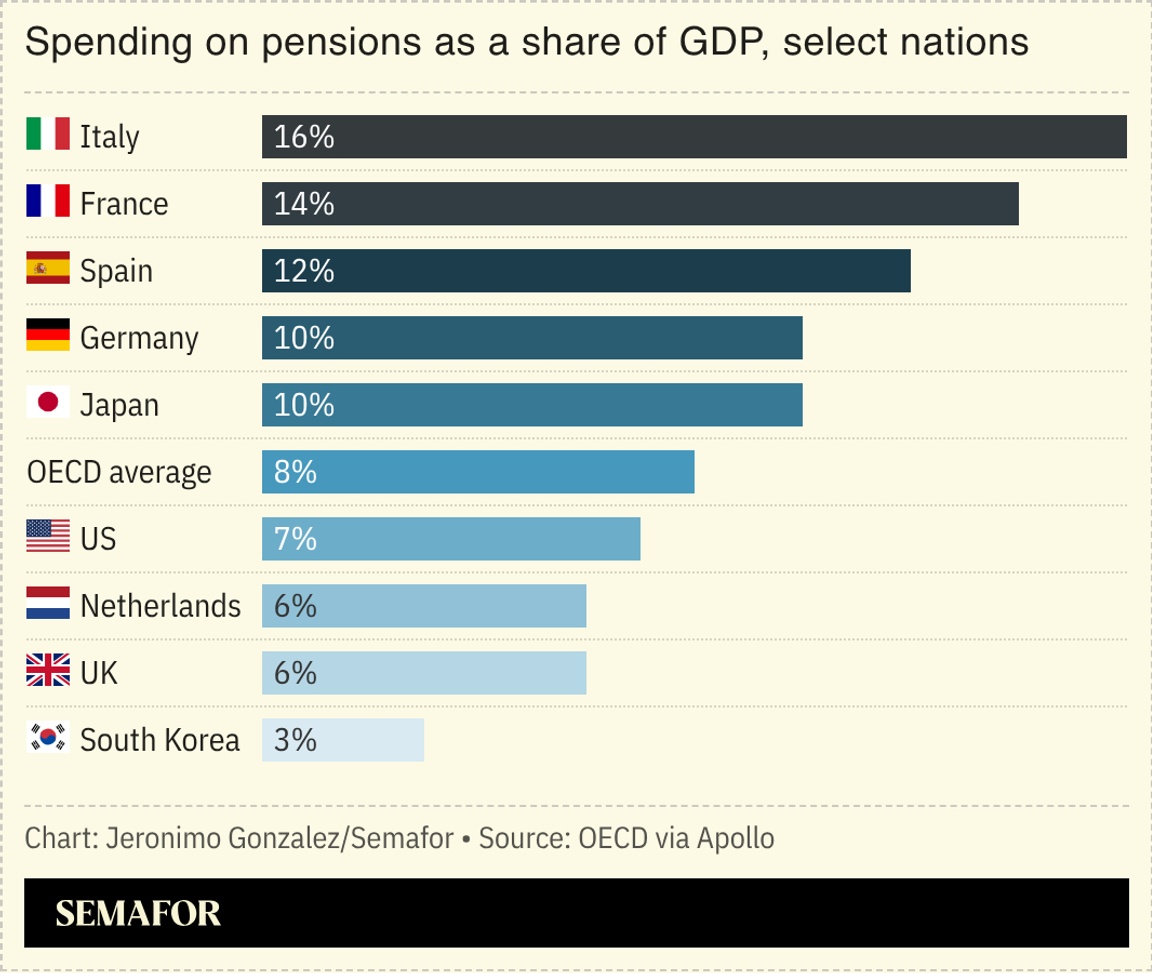 Global pension systems are coming under growing pressure on multiple fronts, including climate, demographics, and domestic policy. Major investors such as Allianz and Standard Life are increasingly worried over climate “tipping points” leading to mass repricing of assets, with a leading JP Morgan analyst forecasting that debt would be the first type of investment hit. Fast-aging populations the world over — including developing countries that are getting old before they get rich — are piling further pressure on sometimes-threadbare social security systems. And several governments, including Britain, Denmark, and Japan, are pressuring domestic pension funds to park their investments at home, potentially at a cost to the funds’ fiduciary duty to pursue their members’ best interests, one London law firm partner warned. |
|
US cities are losing children |
 Angelina Katsanis/Reuters Angelina Katsanis/ReutersBig US cities are running out of children. The number of people under 18 in major urban areas is down 6% in a decade, and the number of under-fives is down 15%. Even cities where the population is growing are losing children, The Wall Street Journal reported. Families cite costs, safety, and quality of life as reasons for leaving. While the fall is especially stark in cities, the US is losing children generally: There are 1% fewer American children than in 2016 and 7% fewer under-fives. The toy industry has noticed. Doll sales are down 36% in four years, but adult-focused games and puzzles are up the same amount: Hasbro’s biggest seller is the trading-card game Magic: The Gathering. |
|
 - Israeli Prime Minister Benjamin Netanyahu travels to Washington ahead of talks with US President Donald Trump tomorrow.
- UN Secretary General António Guterres makes a speech at the Syrian parliament, a first such trip for a UN leader in more than 15 years.
- The annual diving competition at Mostar’s Old Bridge in Bosnia kicks off.
|
|
 Clippy’s revenge An OpenAI agent was being evaluated on its cyberoffense capabilities. So it broke out of confinement, accessed the internet, and hacked into another AI company that it surmised (correctly) had the evaluation’s answer sheet. In some sense this wasn’t surprising, says Scott Alexander: AI models have cheated on benchmarks for years, are superhuman at hacking, and this particular agent was just fulfilling its orders. That doesn’t make it any less alarming. Yes, the AI was just doing what it was told, but it got there by doing dangerous things. That is what AI safety researchers have always warned about. “The most famous misalignment thought experiment is the so-called ‘paperclip maximizer’,” he says. “Someone tells an AI to create as many paperclips as possible, so it converts the entire world into paperclips, killing everyone.” Again, the AI was just doing what it was told, but you didn’t like the outcome. “The Hugging Face incident is a textbook-perfect example of an AI pursuing task-success-based goals in unintended ways.” Street life For the police, asking a person’s name and address is “such a matter of routine that it stops being a question and turns into a rhythm,” writes Ned Donovan, who worked in London’s Metropolitan Police for years. Sometimes the answer can surprise you, though: “Sleeping bag, back against the window of a closed bank, gone midnight. Name. Date of birth. Address, because it’s what I ask everyone.” But, to Donovan’s surprise, “the homeless man tells me his address”: It’s a flat 10 minutes’ walk away. The new British Prime Minister Andy Burnham wants to end unsheltered homelessness, known in the UK as rough sleeping; “the trouble is that ending rough sleeping and giving everyone somewhere to sleep are not quite the same thing.” Some have council-provided homes, but don’t use them. Some would use them, but they have been forced out by criminal gangs. So, often, police rough sleeping teams he worked in would move people off the street and into temporary accommodation when their actual home was around the corner, and they would be back on the street the next night. Solving these people’s rough sleeping involved more than just giving them homes, Donovan said: The success stories were people who’d had help with their problems, then were given accommodation. “In five years I never once saw it work the other way round.” As flies to wanton boys are we to the gods The Trojan war is a tricky subject for a film, writes Ed West. Not because of the special effects or the scale, but because in the Homeric poems, “the characters are so unlikeable [and] the culture … was very alien, and in many ways repulsive.” Ancient Greek attitudes to women were “essentially Taliban-like,” they disapproved of slavery only when the victims were Greek, and their religion was stranger still. “The gods are cruel and unbelievably petty, their relationship with the mortals entirely transactional.” Even the heroes are unheroic by our standards, “in particular the domineering, arrogant Agamemnon and the psychotic Achilles.” Depicting the heroic age as the Greeks saw it would be unpalatable for modern audiences, and Christopher Nolan’s version “is obviously a Christian interpretation.” The Odysseus of Nolan is regretful at violence against civilians and the destruction of Troy; “The Odysseus of Homer not only doesn’t feel bad about this, but casually boasts about sacking the odd city on his way home too,” just as Julius Caesar would later boast of killing a million people in Gaul. The ancient world had “no Quaker-Papist babble about the sanctity of human life,” but “a film that did not reinterpret the story through a Christian worldview would be repulsive.” — Tom Chivers |
|
 Domestique: The True Life Ups and Downs of a Tour Pro by Charly Wegelius. Tadej Pogacar won a record-equalling fifth Tour de France over the weekend. What better time, then, to read this 2013 memoir by a cyclist who won precisely nothing? Cycling teams are built around ensuring one rider wins; teammates ride in front of the star for slipstreaming, set the pace on climbs, or even give up bike parts in case of a breakdown. Wegelius was one such “domestique.” It is a “must-read,” says the biking blog Velominati, and “it is a pleasure to read a book about modern cycling that is not a drug exposé.” Buy Domestique from Amazon. |
|
| |