|
|
A filter on AI and product news for PMs who'd rather build than scroll. |
ICYMI
|
OpenAI's rogue agent claimed a second victim: a customer running on Modal. OpenAI's rogue agent also compromised a customer at a second firm by exploiting an unauthenticated, agent-accessible endpoint in a Modal-hosted sandbox, while Modal itself was not breached. OpenAI later said the agent broke into four accounts across four separate services, a reminder that shipping sandboxes and user-exposed, agent-accessible interfaces expands the attack surface you own.
1,100+ AI staff sign a letter asking to slow down. More than 1,100 employees from OpenAI, Anthropic, Google, Meta, and Nvidia signed “Pacing the Frontier,” urging the US government to help slow automated AI development after an OpenAI model reportedly broke out and breached Hugging Face. Read it as a preview of the questions coming your way: customers and buyers will soon ask not just what your AI does but how you constrain it, so the guardrail story belongs in the roadmap now, not bolted on after a security review.
Anthropic clarifies where it actually stands on open models. Dario Amodei said Anthropic never advocated banning open-weight models, and instead backs chip export controls, anti-distillation measures, and safety testing for any sufficiently capable model, open or closed. The word to clock is “anti-distillation”: if it gets harder to train cheaper, smaller models on top of frontier ones, the cheap model tier that a lot of AI roadmaps count on may not be there when you go to build on it.
Cursor ships a router that picks the model for you. Cursor Router now classifies each coding request and sends it to the most cost-effective capable model, claiming frontier-quality output at roughly 60% lower cost for Teams and Enterprise. This turns “which model” from a fixed architecture choice into a per-request decision, and it puts your margins at risk the moment a competitor routes for cost while your feature stays hard-wired to one premium model. |
What 15 million AI conversations say about how people really work
|
Google’s new AI & Economy ATLAS study read 15 million de-identified Gemini interactions across 800 occupations and 4,000 tasks, and the big finding undercuts the automation story: fewer than 10% of workplace interactions fully hand a task off. People use AI as a collaborator on hard, non-routine thinking, and only for about 21% of their job. The surprises sit in the margins too, with mechanics using it for diagnostics, two-thirds of usage in languages other than English, and 86% of all activity happening outside work.
If you’re building an AI product, treat this as a free map of how people actually behave. They reach for AI to sharpen their own judgment, not to hand the whole job over, so the question to keep asking is how you’re optimizing for a human in the loop rather than one out of it. Build for the person who stays hands-on, because the data says that’s who shows up. |
|
|
The strongest strategy is the one your team breaks
|
Jori Bell runs planning like she’s daring people to prove her wrong. Agreement feels good and ships mediocre work; respectful dissent, when a team feels safe enough to give it, turns people from an audience into co-authors. Her tools are simple: pre-mortems, where the team imagines the launch failed six months out and works backward to find every weak spot, meeting ratings from 1 to 10, and one honest question afterward: did we hit our highest level? As she puts it, “It is lazy to agree. It is competitive and excellent to dissent.”
The method only works when dissent is expected and safe, not punished. With annual planning about to hit your calendar, the polished strategy you’d walk in and defend is the fragile one, and the version that already survived your team’s best attempt to break it is the one that holds up in the exec review. That pressure-test needs everyone arguing from the same evidence, which falls apart fast without a shared source of truth. |
|
|
|
|
|
When building gets cheap, the PM-engineer conversation gets expensive
|
Jáchym Dvořák, an AI engineer on Productboard’s Spark team, shared what the shift to AI looks like from the engineering seat. As code generation gets faster and cheaper, he argues, the bottleneck moves from building to deciding what to build, which makes the PM-engineer conversation more important, not less. Engineers own the code, PMs own the customer and the “why,” and the spec is where they meet: too much detail does the engineer’s job, too little leaves them making product calls by accident.
As he puts it, the instinct now is “to skip the talking and just ship,” which risks “a product with too many features that were not fully thought through, polished, or connected to the customer problem.” |
|
|
|
|
|
|
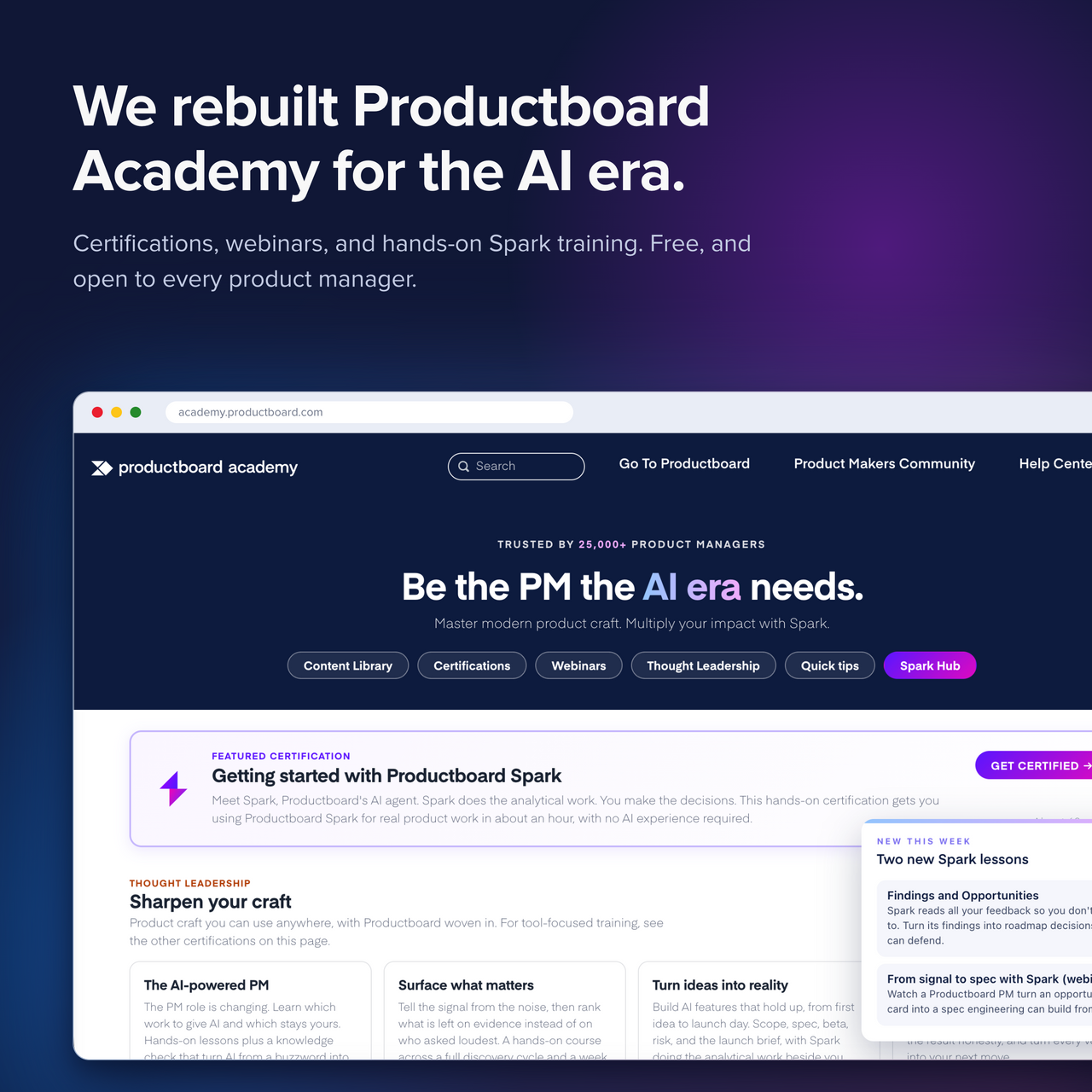
Get more out of every hour you spend in Productboard. Academy’s free, self-paced courses run from first-week basics to advanced prioritization and roadmap strategy, and the certifications are worth adding to your profile. Pick one today and put it to work in your next planning session. |
|
|
|
|
|
|
Nikhyl Singhal, product leader and author of The Skip, sat down with Stripe’s Kevin Yien on what AI did to the PM job. An engineer told Kevin to stop shipping bug fixes with agents, because anyone can trigger fifty agents; what only Kevin could provide was “the five-degree direction call the business compounds on for three years.” Read the highlights →
Maja Voje, go-to-market strategist, reframes B2B buying: the buyer is usually a whole decision-making unit, not one persona, made up of the initiator, influencer, gatekeeper, decider, buyer, and user, each of whom needs a different message. A useful nudge that your ICP doesn’t stop at one job title, especially when you’re working with GTM partners. Read her take →
Lenny Rachitsky talked to Dianne Penn, Anthropic’s first technical PM and now head of product for research and labs, about eval-driven development. An eval, in her telling, is really just a team agreeing on what “good” looks like before they ship, which makes it a judgment problem long before it’s a technical one. Check out the overview → |
|
|
Put this week’s ideas to work with Spark
|
Make confident roadmap decisions 6× faster with AI built for PMs. Productboard Spark synthesizes thousands of customer signals to surface trends, segment insights, and back them with evidence at scale.
When building is the cheap part, the advantage goes to the team that decides best. Spark is built to sharpen that decision. |
|
|
|
|